Rheology of rocks (models for stress-strain
relationships)
Alfred Wegener
"All that can be said with certainty is that the earth
behaves as a solid, elastic body when acted upon by short-period
forces such as seismic waves, and there is no question of plastic
flow here. However, under forces applied over geological time
scales, the earth must behave as a fluid: for example, this is
shown by the fact that its oblateness corresponds directly to
its period of rotation. But the critical point in time where elastic
deformations merge into flow phenomena depends precisely on the
viscosity coefficient."
The concept of rheology is needed to make sense of the earth.
Lecture index: Utility
of understanding stress-strain relationships. / Five
components of a constant load test in strain time space. /
Three models to explain stress strain
relationships. / Combination models
and definition of rheid. /
Reading: Chapt.
6 in Fossen, Structural Geology
Utility of understanding stress-strain relationships
Stress-strain relationships are important because:
- elastic stress-strain relationships are crucial to understanding
seismic waves.
- these are tje basis of in-situ stress measurement.
- they are fundamental for geologic engineering.
- understanding important geologic phenomena
including:
- isostatic rebound.
- ductile deformation.
- mantle convection.
Five components of a constant load test in strain time
space

An idealized constant load (constant stress) test result looks something like the above. Strain over time is the strain rate, and so changes in the slope of the line represents changes in strain rates. The temperature, pressure, material properties, and load amount all influence the specific shape of the curve. The curve shown here is for conditions that produce the full suite of components. Under certain conditions only limited portions of this behavior will be seen.
How can we model this behavior? First, we can
divide it this history into separate components.
- elastic response:
immediate and recoverable.
- primary creep:
decelerating strain rate.
- secondary creep:
constant strain rate (viscous behavior).
- tertiary creep:
accelerating strain rate that leads to failure.
- brittle failure.
- Tertiary creep is often result of high loads
needed to produce deformation under lab conditions and within
human time frames. It is important engineering wise. Lower loads,
hotter conditions, etc., lengthen secondary creep, permitting
unlimited ductile deformation. Thus, for ductiley deforming rocks
the goal is to explain up to secondary creep.
- alternative testin environment is a constant strain rate instead of a constant load.
Three models to explain stress strain relationships
These are idealized simple mechanical models,
each with their own iconic representation.
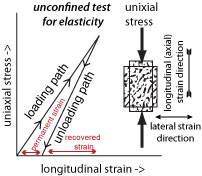 elastic:
- E=Youngs modulus = stress / axial elongation
- similar to spring stiffness constant.
- measured under uniaxial
compression.
- uniaxial loading path, get mixture of permanent
and recoverable deformation, recovery path used to compute E.
- There is also a Shear modulus (rigidity)
= shear stress/shear strain.
- Poisson's ratio = lateral/longitudinal elongation;
- permissible values 0 -> .5.
- no compressibility then = .5, totally collapsible
then = 0, rocks typically .25.
- 'sponginess'.
- as saw in previous discussion of lithostatic gradient, this parameter is important in the transmittal of stress.
- bulk modulus another elastic constant (K).
- tensor description allows for description of directional elasticity. Individual
crystals are anisotropic elastically.
- iconic depiction of elastic behavior as a spring (see below).
- plastic:
- yield strength, incomplete description, doesn't
specify strain rate.
- question as to fundamental strength.
- a threshold at which deformation initiates.
- iconic depiction as a friction block (see below).
- viscous:
- stress = viscosity x strain rate, or viscosity = stress/strain rate; cgs units for viscosity -
poise, with 1 poise = .1 Pa sec.
- defined in stress strain rate space.
- note
implied lack of fundamental strength.
- Newtonian vs. power law types of viscosity;
e = (1/µ) s^n
- Newtonian viscosity, n=1
- for many
rocks n=3-5 range.
- nonlinear indicates as shear strain increases that shear thinning is occurring (internal weakening).
- atomic level what is going on? Bond breakage
and formation - as things get hot atom neighbor swapping accelerates.
- iconic depiction as a dashpot (see below).
Combination models and definition of a rheid
Linking these three components in different
ways produces some 'emergent' behavior.
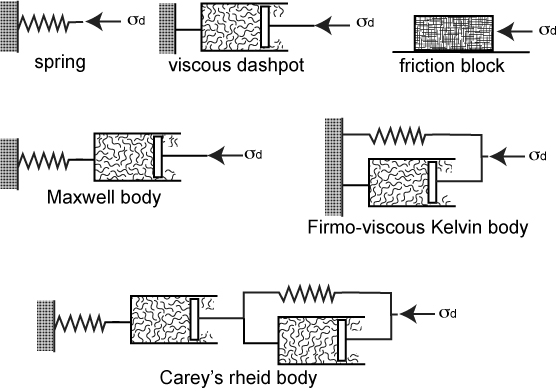
The top row depicts three basic deformational behaviors that can be combined to build models for more complex behavior. The second row depicts models of the the spring and dashpot combined in series, and then in parallel. The lower most depiction is with the two modes above combined in series, and this model reproduces elastic, primary and secondary creep behavior as depicted and described above.

Consider the 3 time and stress constant load curves above. Note that mid-way the driving stress (the load) is removed and recoveryis possible. Which one best represents the Maxwell body, which one best represents the Kelvin body, and which Carey's rheid body?
- Maxwell body:
- spring and dashpot in series.
- models secondary creep component.
- missing primary creep.
- recovery of the elastic spring component, but dashpot component permanent.
- Firmoviscous Kelvin Body:
- spring and dashpot in parallel.
- models primary creep.
- time recoverable deformation, all of it.
- can be used to model glacio-isostatic rebound
and mantle viscosities. Works on time frames of thousands of
years for earthly deformation conditions.
- Carey's rheid body:
- Maxwell and Kelvin body in parallel.
- models primary and secondary creep.
- e(t)=(2s/9K) + (s/3G2)
+ (s/3G1) - (s/3G4) * (e^-(G1t/h1)) + (s t / 3h2)
- the Gs are spring constants, K is the Bulk Modulus
- 2nd term -> spring in Maxwell body
- 3rd term -> spring in Kelvin body
- 4th term -> dashpot + spring in Kelvin
body
- 5th term -> dashpot in Maxwell body
Definition of rheidity:
The units are time. The rheidity of a given material is the
time at which the permanent deformation = 1000 times the recoverable
deformation. At this point you can consider the last term
to dominate and the material is acting like a viscous fluid for
those time frames. If deformation conditions persist for this
amount of time then the finite deformation can be treated as viscous.
YouTube demonstration of rheidity (time dependent behavior): http://www.youtube.com/watch?v=f2XQ97XHjVw.

Dr. John Mainstone at the University of Queensland (Australia) and the slowly dripping pitch. About one drip per decade occurs. Image source: http://en.wikipedia.org/wiki/Pitch_drop_experiment . More images and web cam at http://smp.uq.edu.au/content/pitch-drop-experiment .
For rock salt and normal crustal conditions
rheidity is about 10 years. Rheidity and viscosity are very sensitive
to temperature.
Link to salt flowage image and information.
Copyright Harmon D. Maher Jr., This may be
used for non-profit educational purposes as long as proper attribution
is given. Otherwise, please contact me. Thank you.