 Physical geology lecture outline
- Igneous Rocks
Lecture index:
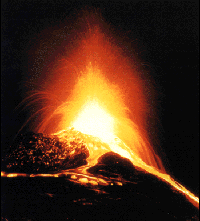
Image to right: lava fountain from Kilauea basalt flow eruption. Source USGS - https://pubs.usgs.gov/gip/hawaii/page29.html .
Types of rocks
rock -> a naturally occurring
aggregate of mineral matter.
 Major divisions of rock types:
- igneous
- sedimentary
- metamorphic
- hydrothermal
- Is this a classification based on description
or on genesis?
- This classification is directly linked to the rock cycle.
Sketch of part of Yosemite National Park, deep in the heart of an igneous world, the Sierra Nevada Batholith. Image Source: http://geomaps.wr.usgs.gov/parks/yos/I_1639.html
How do we tell an igneous rock from a sedimentary one from a metamorphic one?
- by closely observing multiple traits such as texture, context, association, and mineralogy.
- e.g. if it has fossils it is a sedimentary rock (although it could be a sedimentary rock that has been weakly metamorphosed, such as slate, and thus be a metamorphic rock that once was sedimentary).
- e.g. if it has large crystals of a mineral that only grows in the solid state under higher pressures and temperatures, such as garnet, then it is likely metamorphic.
- e.g. if it has larger well formed crystals in a fine-grained matrix of interlocking crystals, it is likely volcanic and therefore igneous in origin.
- many distinctive traits which you will learn some of in the following lectures.
Igneous rocks overall
Igneous rocks and the process of crystallization (cooling and phase change from liquid to solid):
-
disassociated ionic groups --> lattice
structure.
-
liquid (solution) --> crystalline solid.
-
salty water --> ice and salts.
-
magma/lava --> plutonic rock/volcanic
rock.
-
granitic melt --> granite.
In
what different ways can the crystallization process be studied
and observed?
Bowen's reaction series - a schema for the order of mineral crystallization from silicate melts.
This is a very useful framework for understanding igneous rocks.
Grain size texture:
- phaneritic
= coarse grained, individual mineral grains identifiable by eye; aphanitic = fine
grained, individual crystals to small to be identifiable in a hand specimen.
- What
controls the grain size of an igneous rock?
- Volcanic vs.
plutonic rocks = aphanitic versus phaneritic.
- Given the above there is the initial enigma of phenocrysts, which are larger crystals in a distinctinctly finer grained matrix in igenous rocks. Why are only some of the grains coarse, while the surrounding matrix is aphanitic (and thus of volcanic origin)?
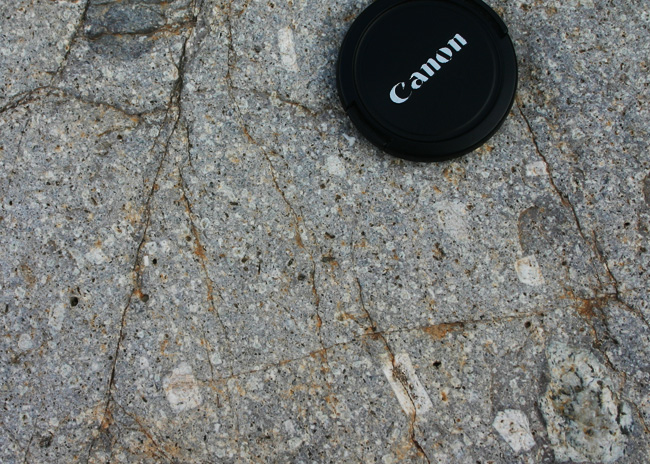
This rock is from a very shallow intrusion in Death Valley. It shows the larger phenocrysts (the larger white and rectangular crystal of feldspar) in the finer grained matrix. Much smaller feldspars also exist.
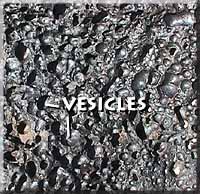 How does one identify a rock as volcanic?
Volcanic rock types from poorer in SiO2 to richer in SiO2: komatiite (rare) -->
basalt --> andesite/dacite --> rhyolite. For each, Bowen's Reaction Series predicts what mineral type of phenocrysts should be present (if phenocrysts are present).
3 tectonic settings for volcanism:
- volcanic arcs associated with subduction - e.g. the Pacific "ring of fire".
- where in the U.S. do we have volcanoes associated with subduction (and part of the ring of fire)?
- rift zones (two types continental and oceanic).
- where is the closest rift zone to Omaha, Nebraska?
- hot spots.
- where is the closest hot spot to Omaha?
How do you melt source rocks to create magma?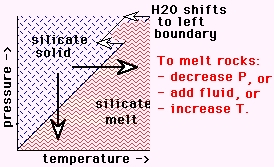
Figure of phase space for silicate melt. The space
makes intuitive space. The hotter the more likely it will be
molten. The higher the pressure the more likely it will be solid.
Note that material can move from the solid to the melt field
in at least three different manners: reducing pressure while
keeping temperature constant, increasing temperature, and by
shifting the boundary .
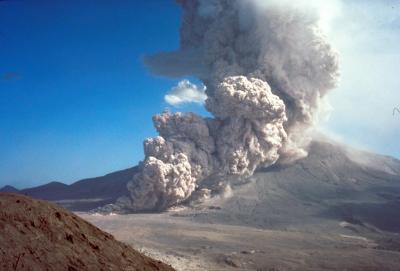
Types of volcanic eruptions?
- flows vs. pyroclastic.
- types of pyroclastic events:
- ash fall
- well exposed ash beds occur throughout Nebraska including
the well known Ash Fall site near Royal and Orchard Nebraska.
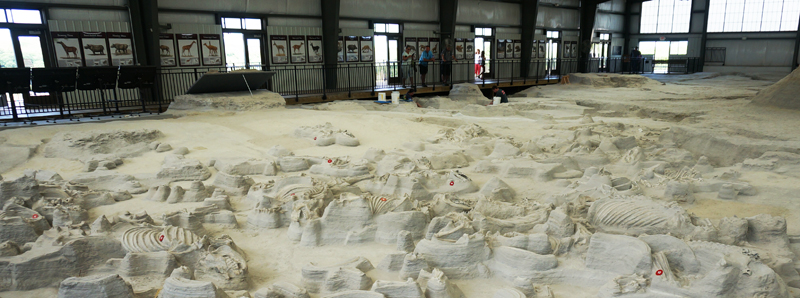
- Rhino barn at Ash Fall State Historical Park. The ash and dying critters collected together in this watering hole. The ash was from an eruption in Idaho circa 10 million years ago - evidently a rather large eruption.
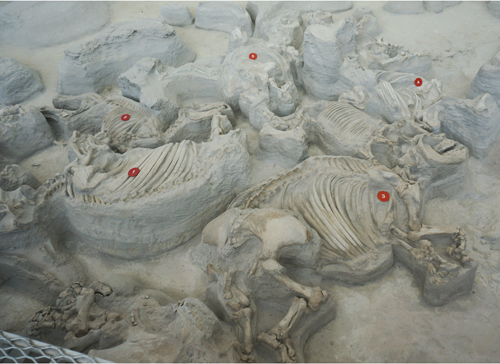
- Close up of some of the well preserved critters in the white powdery volcanic ash, including a barrel-chested rhino species, and in the upper left, a small horse species that used to roam the Nebraska Plains.
- more information on Ash Falls State Historical Park.
- pyroclastic flows (one type of volcanic debris flow):
- lahars, volcanic mud flows:
- Jemez volcanic center pyroclastics.
shield volcanoes
versus strato- or composite volcanoes.
- shield volcanoes traits:
- predominantly basalt flows.
- low angle slopes.
- small collapse calderas.
- Mauna Loa.
- composite volcanoes (also known as stratovolcanoes) traits:
- interlayered flows and pyroclastics, usually
intermediate to sialic in composition.
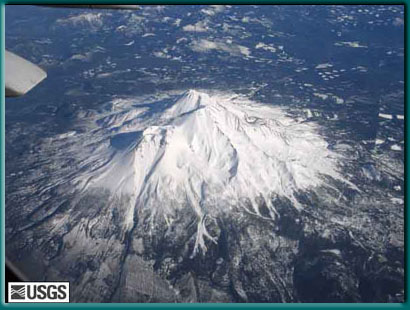
- higher angle slopes (cone shape).
- larger calderas.
- Mt. Fuji and Mt. St Helens are two well known examples.
- USGS video of Mt. St. Helens eruption.
- short clip showing the mass wasting event on the volcano's side triggering the eruption.
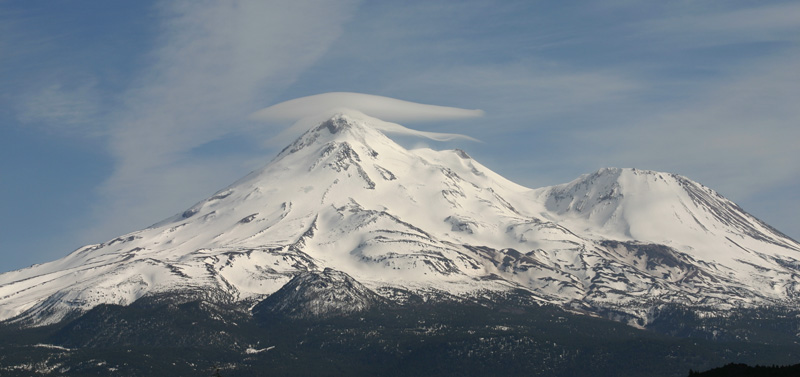
- Image to the right is aerial image of Mt. Shasta in northern California, one of the more southern volcanoes in the Cascade volcanic chain that includes Mount Ranier and Mount St. Helens. Below is image of Shasta from the ground as seen on a 2011 UNO field trip to northern California. Note the relatively high angle slopes, and the composite character of this volcanic construct, with a smaller cinder cone in the foreground, and a secondary volcanic mountain to the right.
- Why the difference between the two volcano types?
flood basalts
and volcanic plateaus and large igneous provinces (LIPs):
What is the magmatic plumbing beneath volcanic activity?

Schematic diagram showing how volcanic rocks and features at the surface are connected to shallow and deeper plutonic rocks and features at depth. Diagram from USGS site: http://3dparks.wr.usgs.gov/lame/html/lame_history.htm
 Plutonic rocks
Map and/or cross
section relationships of plutonic rocks give insight into their genesis.
What are intrusion geometries:
- planar intrusions: dikes and sills (discordant
and concordant), see above diagram.
- irregular intrusions (proverbial blobs):
stocks, batholiths.
- in what tectonic setting do batholiths form?
- La Paz batholith, Baja California.
- Yosemite National Park - deep in the heart of a batholith, exposed by tectonic uplift and glacial erosion.
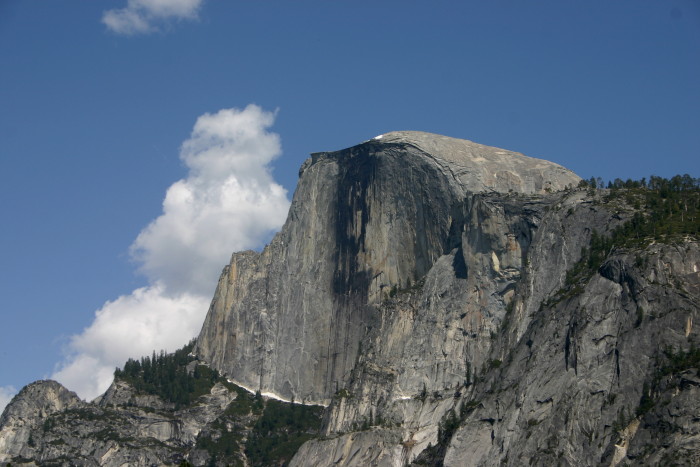
- Photo to right is of the iconic Half Dome. While there is a distinctive set of fractures, note how all the rock has basically the same color. It is all massive granite. The granite extends much farther than this, and dominates the landscape for 360 degrees around the point of this view. Many granite intrusions from below combined to make a massive composite intrusion that is the center of the Sierra Nevada Mountains in eastern California. The associated cliffs are a mecca for climbers.
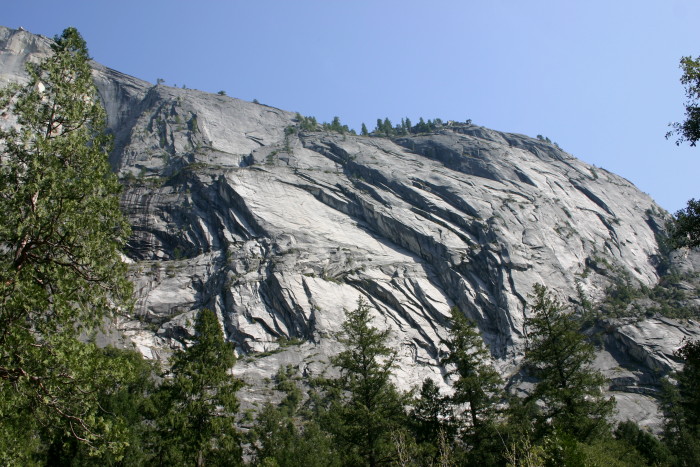
- Not always but commonly a distinction type of fracturing occurs in these large granite bodies, a style of fracturing known as exfoliation jointing. It is well displayed here in this image from Yosemite, and the pattern has reminded some of the peels of an onion skin. This is a landscape dominated by granite and shaped by fracturing and erosion by glaciers.
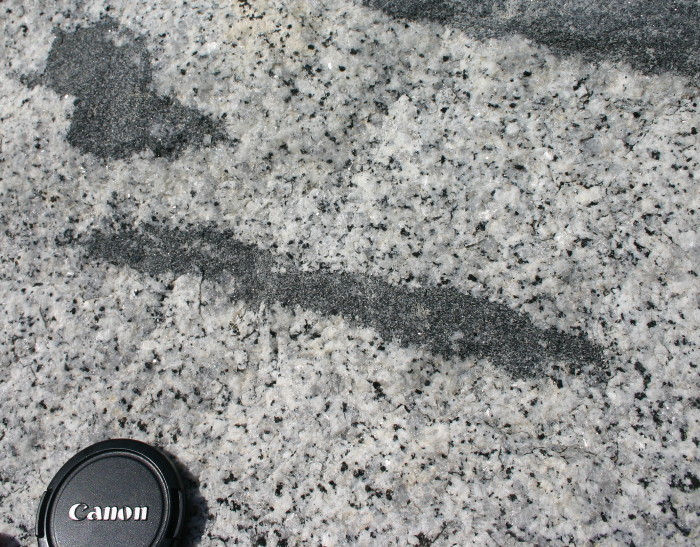
- Above is a close up image (camera lense for scale) of the Yosemite granite with some foreign bits of the rock that the granite intruded caught up and then frozen into the granite. These pieces are known as xenoliths. Note the massive and crystalline (interlocking) texture in the granite.

- In this photo there is almost more xenolith material than the lighter colored granite. That is because at this point we are at the very edge of the granite intrusionand of the Sierra Neveda batholith in Yosemite, near its contact with the surrounding country rock that it intruded. If you look carefully at the shapes and margins of the xenoliths, there is evidence of interaction between the xenoliths and granites - some faces look corroded.
What are plutonic rock types from ultramafic to mafic to sialic (remember Bowen's reaction series as a framework for different compositions of igneous rocks):
So a gabbro magma chamber may have fed basalt eruptions above and a granite magma chamber may have fed rhyolite eruptions above.
How and why do magmas ascend through the crust?
- like a blob?
- squeezed along cracks?
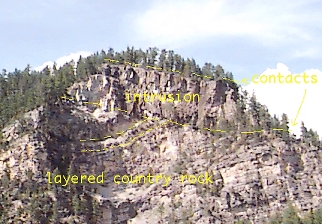 Image of a sheet like (tabular) intrusion cutting the
Madison limestone in Spearfish canyon in the Black Hills. This
body is part of a suite of intrusions of Tertiary age found concentrated
in the N part of the Black Hills uplift. Devil's Tower is a part
of the suite.
Harmon D. Maher Jr. reserves copyrights
to the materials in this site. Material may be used for non-profit
educational purposes as long as proper attribution is given. For
permission for any other use please contact author. Thank you.
Return to Physical Geology index
page.
Return to my home
page index.