 GEOL 117 - PHYSICAL GEOLOGY COURSE
SYLLABUS - Spring 2019
Harmon D. Maher Jr.
Remember that you are also signed up for
the lab portion of the course.
How to contact me?
- Office: Durham Science Center, Dept. of Geography &
Geology Room 266 (I am in my office a lot, and if you are nearby feel free to stop by).
- Phone number: 402 -554-2662.
- Office hours M,W,F 9-10 AM and T,Th 8:45 to 9:45 AM, or by appointment
(best to contact me by email).
- email: harmon_maher@unomaha.edu (the best way to contact me).
Exams and grades: Grades will be posted on Blackboard.
- The grading scale is the classic one, although I reserve the right to curve it in your favor:
- 100-96.66 A+, 96.66-93.33 A, 93.33-90 A-, 90-86.66 B+, 86.66-83.33 B, 83.33-80 B-, and so on.
- Positive consideration will be given if the first exam result is anomalously
low and consistent improvement is shown as the course progresses.
- Your grade will be based on:
- 3 exams each at 20% each, 60% total. Exams are a combination
of matching, short answer and diagrammatic question. Copies of
old exams are available.
- Your lab grade is worth 25%
of your total grade.
- 15 % is participation (unannounced in-class labs, discussion contributions, and in field trips).
Points will be awarded for each participation element, with 15 points considered a full complement (100% for the particiption part of your grade). There will be 17 or more points worth of opportunities for participation.
- The penalty for cheating
is failure of the course.
If you have any questions about what is permissible please ask.
Policy on make-ups: If you must miss an exam, and if
you contact me before the test, then
arrangements can usually be made for you to take
a make-up exam early (at my discretion). If you miss an exam without
making arrangements beforehand, then you must take a make-up that
will be given during finals week. The make-up will be essay in
form. It is to your advantage not to miss the exams. You will
be given at least a two week notice in class of the exact date
exams will be given. They will be spaced roughly at even intervals
during the semester.
I am happy to work with those of you with designated accommodations. Please coordinate implementation of those accommodations with me at least two days prior to a test or assignment where an accommodation is provided.
Text: This web site is the equivalent of your text book. Reviewing the material before the
lectures can significantly increase efficiency of learning. With discipline you can
spend less time overall and get more out of the course material.
Electronic devices in class: Research and experience are quite clear, use of phones, tablets, and even computers not only decreases the user's learning, they are significantly disruptive to others. Therefore, their use is not allowed in the classroom during lecture. There may be special individual circumstances, and so I am willing to discuss a specific use on a case-by-case basis.
Hopefully helpful points:
- Ask questions! Questions are the lifeblood of science. They feed curiousity. Importantly, they provide invaluable feedback to your instructor as to what is and isn't being understood.
- Its OK to feel lost. Science is powerful, deeply satisfying to many participants, but it is also challenging, especially at first brush. As a result discomfort can be involved. As I start out to learn something new I often feel 'stupid', but I also expect to feel that way. With time and effort that feeling can fall away.
- Take copious class notes: Writing and drawing engage the brain more deeply. Thus, if you want to make the most of your time in class, the best strategy is take copious notes.
- Time commitment to this course: Here is the basic reasoning. Given 15 credit hours is a full load, and that a typical work week is roughly 40 hours, then one can be expected to spend 40 divided by 15, or 2.66 hours per course credit per week. For this 4 credit course that is a bit more than 10 hours a week. Some 5 hours a week is spent in lecture and lab attendance, leaving the rest of the time for self directed learning. The actual amount will shift from week to week. Those weeks that there is an exam will require more and those without less. However, the basic take-away is that you will need to spend time outside of class learning this material in order to do well, or even to pass. The best predictor of success is time on task.
- Help is available: Start with me when you feel you are struggling. I will be happy to help. In addition, we have the Math Science Learning Center (bottom floor of DSC) who can provide geology tutors.
If you have any questions please ask!
Link to lecture outlines.
Field Trip: Without a doubt the best place to learn
geology is out in the field, and so we will take a Saturday morning
field trip (usually to a local quarry). Good fossil collecting! This will be worth participation points - details
are forthcoming.
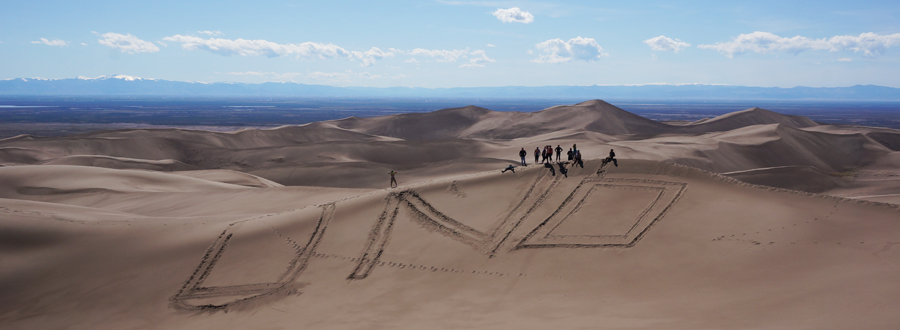
UNO students on a 2016 geology field trip to Great Sand Dunes National Monument in Colorado standing on the shifting sands fo time.
Return to Physical Geology index
page.
Return to my home
page index.
I reserve copyrights to all the
material in this site. Students are free to use or copy any material
within for their individual educational purposes.