Lessons from the Indian Ocean earthquake
and tsunami.
Background information:
- On Dec. 29, 2004 a very large 9 earthquake
struck in the Indian Ocean.
- The earthquake was produced by perhaps 15
meters of slip along a 1200 km long segment by 100 km long (source).
The area over which slip occurs determines the size of an earthquake.
The hypocenter, the point of initiation was only 16 km deep,
which is shallow.
- The earthquake occurred on an oblique subduction
zone, a type of plate boundary known to be able to generate large
earthquakes of the type that can also produce tsunamis.
- It caused large destructive waves called
tsunamis that hit coastlines throughout the area.
- The wave swept over entire small islands,
and inland in low lying coastal areas as much as two miles.
- The estimate of fatalities from both the
tsunami and earthquake is now stabilizing around 150,000. As
of this writing no one has attempted to come up with an estimate
for loss of property.
- It was predictable, and in a sense was predicted.
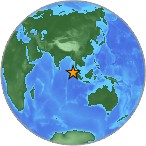
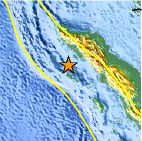 Images from USGS
NEIC website.
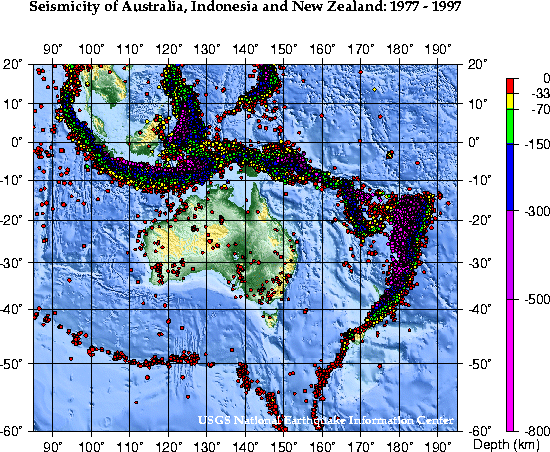
Many lives could have been
saved (and some were). How?
- Simple when-to-run-away knowledge. There are precursors to the tsunamis arrival. The
water withdraws from the shore more extensively and more quickly
than during a normal tidal cycle. One must flee immediately for
this warning to do any good.
- Simple knowledge that tsunamis come in
multiples. If one tsunami comes in,
even if small, stay away from the shore for at least several
hours. The second or third wave can be even bigger.
- Identifying the nature of tsunami risk
and zoning. An important part of identifying
such risk is how often such an event might occur. A good estimate
of the recurrence interval of this size earthquake can be made
from looking at the history of past earthquakes in the area.
A simple preliminary analysis using data off the web indicates
that earthquakes of size 9 can be expected in the area every
600 years or less. Not all earthquakes produce tsunamis, and
this would reduce the tsunami risk. But, tsunamis can be and
have been caused by volcanic eruptions in the area (e.g. Krakatoa,
and Tambora). The Krakatoa tsunamis killed 40,000 people. A list
of other tsunamis in the area is given below. More frequent earthquakes
greater than 7.9 magnitude are also capable of producing tsunamis
(albeit smaller ones). Using computer models, historic behavior,
data on topography and bathymetry, areas with significant tsunami
risk can be identified. In those areas, people should not live
and critical facilities such as hospitals should not be sited,
and people should be informed about the risk and possible responses.
Rebuilding should take this into consideration!!
- The installment of a tsunami warning system
and education of people about proper response. One estimate is that such a system could cost circa
ten million dollars - in hindsight a pittance. A tsunami warning
system exists in the Pacific.
USGS compilation of tsunamis that had occurred
in the area.
- " 1. 1797: A magnitude 8.4 earthquake
near the central part of the western Sumatra generated a tsunami
that flooded Padang. More than 300 fatalities.
- 2. 1833: A magnitude 8.7 earthquake near
the south coast of the western Sumatra triggered a huge tsunami
that flooded the southern part of western Sumatra. Numerous victims.
- 3. 1843: A tsunami that came from the southeast
and flooded the coast of the Nias Island. Many fatalities.
- 4. 1861: A magnitude 8.5 earthquake affected
all the western coast of Sumatra. Several thousand fatalities.
- 5. 1881: A magnitude 7.9 earthquake in the
Andaman Island region generated a 1 m high tsunami on India's
eastern coast. (http://cires.colorado.edu/~bilham/Oldham1881account.htm)
- 6. 1883: Krakatoa explosion. 36,000 fatalities,
primarily on the islands of Java and Sumatra.
- 7. 1941: A magnitude ~7.7 Adaman Islands
earthquake. Anecdotal accounts exist of a tsunami, however, no
official records exist. "
Some conclusions:
- Globally, the largest payout for insurance
companies year after year is for natural disasters, with flooding
and earthquakes topping the list. We have the knowledge to prevent
or mitigate much of the loss of life and property associated
with natural disasters, but it is not being utilized to anywhere
near its full extent.
- Earth science education is crucial, and can
save and improve lives significantly.
- People have much greater difficulty dealing
with the risk posed by rare but devastating events. It is very
important to take a long term approach.
Further
detailed information on the earthquake and tsunami from Columbia
University.