Radiometric dating - internal clocks
in rocks
Geochronology: the science of dating geologic
materials
Outline:
Basics of radioactive decay and isotopic
dating

Radioactive decay occurs at an exponential rate, meaning that
it can be described in terms of a half life. After one half live,
half of the original radioactive isotope material in the system
under consideration decays. Another half life and half of the
remaining material decays, and so on. This is for unforced decay.
Forced decay is when the isotopic material is packed densely enough
that a decay in one unstable atom sends out a particle that hits
another atom and causes it to decay. If it is packed too densely
there is a run away reaction and one of those unpopular mushroom
clouds or meltdowns. Normal concentrations of radioactive material
on earth are well below the levels where forced decay occurs so
we can use the relatively simple mathematics of exponential decay
to describe the process. the rate of decay is constant for earthly
P-T conditions.
A major assumption is that the rock or mineral
being dated has been a closed system so that no parent isotope
or daughter product has escaped or been added. This assumption
can be tested for.
Systems commonly used for radiometric dating,
with half lives.
- uranium 238 --> lead 206, 4,510 Ma (Ma=
Millions of years).
- rubidium 87 --> strontium 86, 47,000
Ma.
- potassium 40 --> argon 40, 1,300 Ma.
- carbon 14 --> nitrogen 14, 5,730 years
(note this is much shorter).

- Major istopes used for dating purposes. Diagram courtesy of USGS.
For more information on radioactivity and geochronology - USGS site - http://geology.cr.usgs.gov/capabilities/gronemtrac/geochron/geochron.html .
What event is being dated?
What event sets
the clock, or more succinctly, when is the 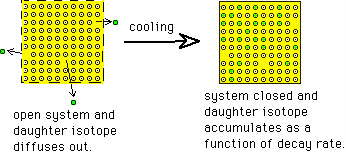 system closed?
- significant thermal control on diffusion
rates and hence on system closure.
- age of crystallization one possibility:
- zircons (type of mineral common in granites) and U-Pb dating.
- easier for volcanic rocks at surface sinice cool quickly (have a simpler thermal history).
- time of cooling through closure temperature:
- muscovite, K-Ar dating, and time of end of metamorphism.
- more complicated because metamorphic rocks can have more complicated thermal histories.
- time since exposed to cosmogenic radiation
(time since last exposure):
- Carbon-14 system is a good example of
this. time since death and communication
with atmosphere.
- can also date time since burial or time
since exposed using other cosmogenic radiation.
- using different systems on the same rock
can get a thermal history.
- different systems and different materials can date different types of geologic events.
Carbon-14 dating
- with such a short half-life negligible
primordial C-14 left, but it is around, so where does it come
from?
- semi-constant production by cosmic ray
bombardment so semi-constant C-12 vs. C-14 ratio in atmosphere. From other
sources they have worked out history of production and resulting
ratio.
- when alive an organism is in communication
with the atmosphere (part of the short-term carbon cycle) and maintains this ratio of C-12 to C-14.
- when it dies the C-14 decays and the ratio
changes so that by measuring the ratio you can calculate time
since death.
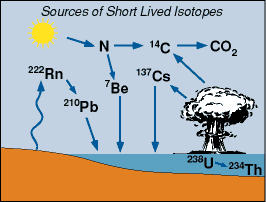
Diagram focusing on some short-lived radioactive isotopes, including carbon-14. Some of these other isotope systems are also used for dating purposes. Diagram from USGS website: http://sofia.usgs.gov/publications/fs/73-98/
What geologic materials can be dated?
This depends on what system is being used,
which determines what type of event is being dated.
- what would the date from a conglomerate
mean?
- igneous rocks generally work well, depending
on composition. Volcanic rocks, because of their quick and simple
cooling history are the simplest to date.
- whole rock vs. mineral separates dates.
Accuracy, error and testing the technique
Some thoughts on accuracy and error:
- measurement or analytic error.
- contamination (violation of assumptions)
error.
Testing the technique:
- Are the results repeatable?
- Are different radiometric clocks consistent
with each other?
- Are the results consistent with geologic
relationships?
- Do materials of a known age (e.g. archeological)
give the right answer?
- Are the results consistent with other
independent rates of measurement?
- technique has been thoroughly tested and
'passes' all the above tests.
Other dating techniques:
- dendrochronology:
use of unique history of annual tree rings.
- continuous history of tree rings back
> 11,000 years, intermittant back to a 20,000 year length.
- used in archeology and geomorphology studies,
provides paleoclimate record.
- fission track densities and fission
track ages.

- The scars of age take many forms. In this
particular case radioactive material distributed throughout certain
minerals leave a scar as an individual atom decays and a particle
goes shooting off through the surrounding lattice structure,
as portrayed schematically in the above diagram. Apatite and
zircon are two common minerals used because they naturally come
with a fair bit of radioactive material. The density of fission
tracks is a function of age since cooling and of the concentration
of the decaying isotope. The latter can be measured for the given
specimen and then the age can be solved for. This has been used
for uplift and cooling histories.
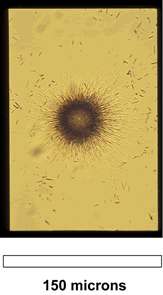 Image from USGS site ( http://energy.cr.usgs.gov/other/uranium/ )of fission tracks around a U rich particle (microscope view).
- crater densities used to relatively date
age of a planetary surface. If can assume or work out a historic
crater flux can assign numbers.
The earth is about 4.5 billion
years old, the oldest rocks are just shy of 4 billion years -
welcome to deep time!
Harmon D. Maher Jr. reserves copyrights to
the materials in this site. Material may be used for non-profit
educational purposes as long as proper attribution is given. For
permission for any other use please contact author. Thank you.
Return to Physical
Geology index page.
Return to my home
page index.