Physical Geology lecture - Geologic resources
and economic geology. Answers to questions.
What are major groups of
geologic resources?
- metallic resources; e.g. aluminum, iron, chromium,
gold.
- energy resources.
- ground water resources.
- industrial rock and mineral resource; e.g. limestone
aggregate, gravel, kaolinite.
- soils.
- sites for waste burial.
- sites for carbon sequestration.
What are concentration processes
that produce ore anomalies?
- hydrothermal processes: hydrothermal circulation cells,
important factors = rock chemistry, water chemistry, P and T conditions,
flux and time
(see previous material on hydrothermal rocks, and diagram below).
- sedimentary sorting and placer deposits:
- both grain size and density are important in the sedimentary sorting process.
- panning for
gold is an example of how heavier grains can be mechanically separated and concentrated by water movement. This can occur naturally in rivers.
- black sands of Florida as an example, but where wave processes are involved in the sorting.
- intense chemical weathering: aluminum as an important
example.
- magmatic differentiation: the Bushveld complex
in S. Africa.
- many others processes. This forms the basis for the
classification of types of ore deposits and for exploration models.
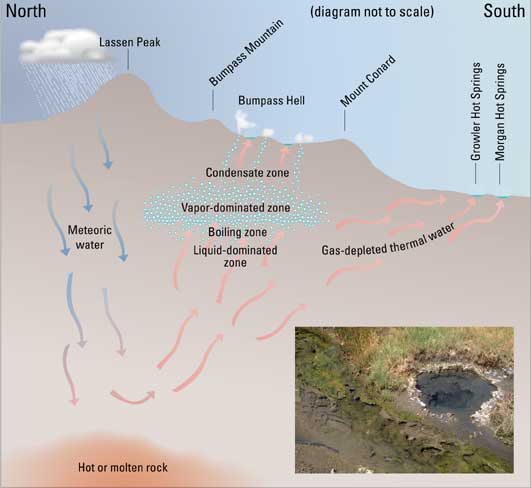
Image from USGS of hydrothermal circulation associated with Lassen Peak in California. Source - U.S. Geological Survey Fact Sheet 101-02 “Hot Water” in Lassen Volcano
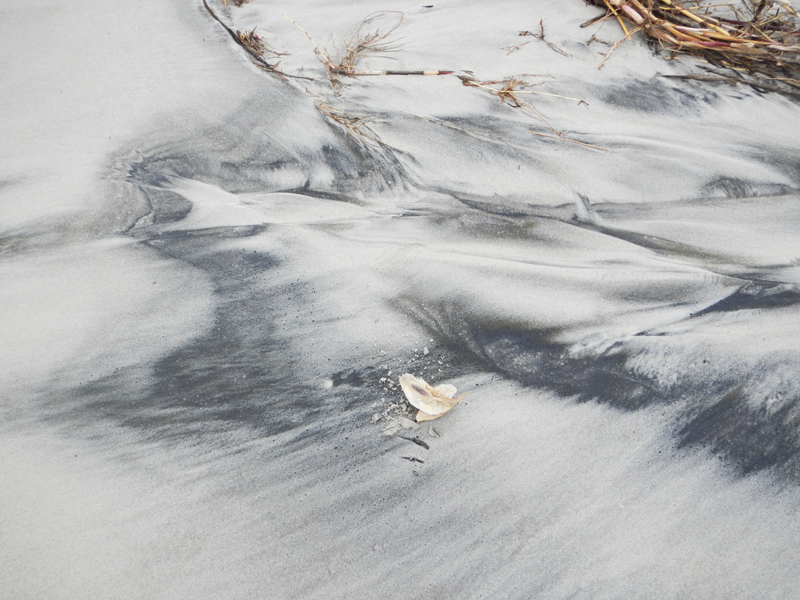
These are sands from part of a beach face along Little Tybee Island in Georgia - note the oyster shells for scale. Quartz is one of the most common minerals in the beach sand here because it is mechanically touch and chemically stable. Most of the quartz is translucent to white. However, there are some 'heavy minerals' such as magnetite, ilmenite, monazite that when concentrated form ore deposits, some of which are rich in rare earth elements. The waves and wind do the sorting and under the right conditions take the lighter quartz sand away and leave the heavier minerals behind. The darker grains here are concentrated heavy minerals.
ic National Park— Fumaroles, Steaming Ground, and Boiling Mudpots: http://pubs.usgs.gov/fs/2002/fs101-02/.
What are the various types
of geologic energy resources?
- conventional fossil fuels: oil, gas, coal.
- unconventional fossil fuels: tar sands, oil shales,
gashydrates (permafrost and sea bottom).
- geothermal.
- nuclear, isotopes of Uranium as primary fissionable
material.
- tidal
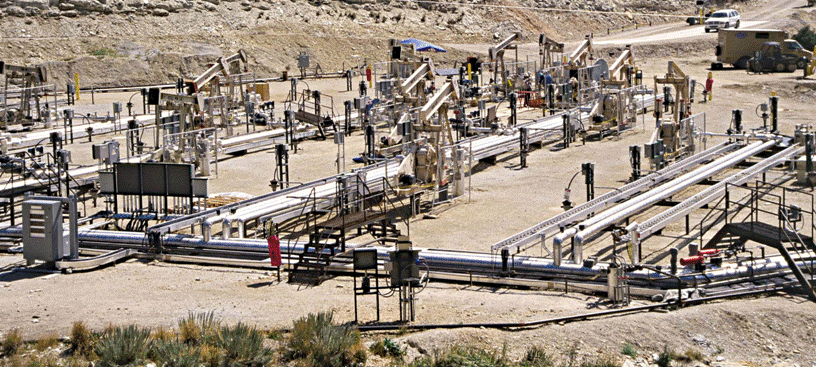
Image of surface oil shale extraction facility. From USGS site: http://energy.cr.usgs.gov/newsite/Templates/oilshaleindex.html
What are the geologic requirements
for formation of oil and gas deposits?
- organic rich source rocks, waxy complex material called
kerogen.
- source rocks need to pass through the thermal window
= right temperatures to cook out the oil and gas and mobilize it. This
is time of oil/gas migration.
- structural and stratigraphic traps. Reservoirs to
hold it.
- the right history of development of these elements.
For example, if a structural trap develops after migration in the area,
then we are out of luck.
How do we explore for oil
and gas?
- drill where oil is leaking out of the ground.
- simple surface extrapolation from geologic mapping
to appropriate traps at depth.
- geophysical techniques to image the interior, especially
seismic reflection (now 3-D).
- conceptual models combined with experience very important.
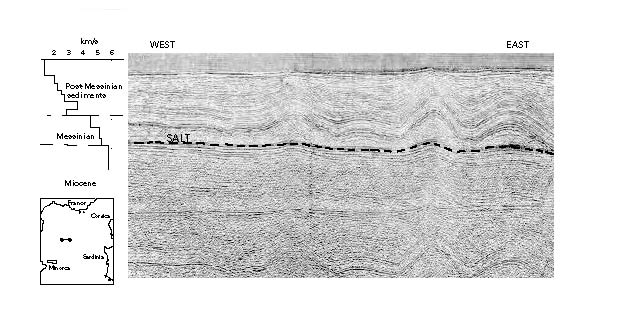
Example of a seismic section from the Mediterranean of the different layers, including a salt layer that has risen because of its bouyancy to form salt domes. Modern seismic imaging is much more powerful in its ability to image buried geologic features. Image from USGS site: http://pubs.usgs.gov/bul/b2204-a/b2204-a.html
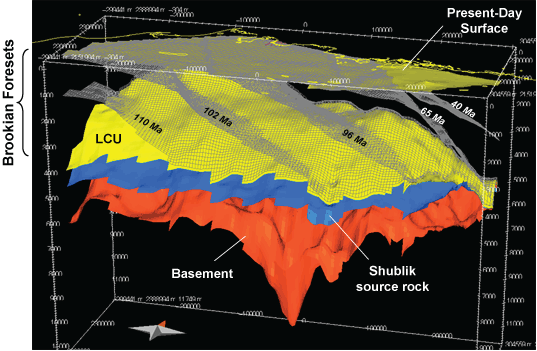
Example of computer generated 3-D model based on seismic and drill-hole data. Image from USGS site: http://energy.er.usgs.gov/gg/research/modeling.html
How much water can the ground
hold?
- porosity - % of void space = % that can be water.
- intergrain porosity:
- space between sedimentary grains, function of grain shapes, range in size, and arrangement.
- of a sand typically 30-40%, of a very well cemented
sandstone several percent or less.
- of a clay can be as high as 60%.
- fracture porosity:
- function of fracture widths, frequencies, interconnectedness. Can be
highly variable within a rock body.
What are the physics of
fluid flow through rocks?
- permeability - the ability of a medium to transmit water due to a pressure gradient.
- rocks such as shales and granites have very low permeability (unless highly fractured), while gravels and sandstones have higher permeability.
- for intergrain porosity - Darcy's law.
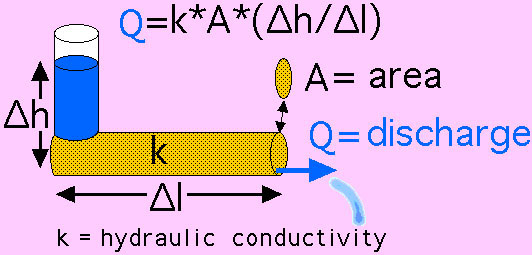
This is a diagram of a Darcy's tube (basically a filter), which allows one to compute the hydraulic conductivity, which is one measure of intergrain permeability.
How does groundwater connect
to the rest of the hydrologic cycle?
- seepage of water into the ground recharges groundwater (faster in some areas, slower in others).
- springs, are where ground water returns to the surface
- direct exchange between surface water bodies and shallow groundwater.
- trapped as deeper formation waters.
- reintroduced as hydrothermal fluids.
© Harmon D. Maher Jr.. May be reproduced
for non-profit educational purposes with source acknowledgement. Otherwise
please contact me.
Return to Physical
Geology index page.
Return to my home page index.