Physical Geology - Test #2, 1999 - Deep time, & surface processes - Practice version
Matching (choose best fit, 2 points each)
| trilobite | A) waterfalls or rapids, migrate upstream as headward retreat, associated w harder layer | |
| Werner | B) unique deposit at end of Mesozoic w high Iridium content & mass extinction boundary | |
| Count Buffon | C) time period of recent major ice ages, from roughly 1.8 Ma to 10,000 ka | |
| half life | D) material deposited by river action in flood plains, the fill part of cut and fill. | |
| tree rings | E) material deposited by mass wasting processes, poorly sorted, nearby sources | |
| boundary clay | F) example of barrier island complex, undergoing transgressive retreat. | |
| alluvium | G) developed a schema of universal formations, given rock type formed in a distinct period | |
| knickpoint | H) site where surface drainage goes subsurface, connected with soluble bedrock. | |
| Gros Ventre | I) differs for different radioactive isotopes, constant under earthly conditions, imp.in dating | |
| colluvium | J) time since about 10,000 years ago and the demise of the last major ice advance. | |
| wavebase | K) used in dendrochronology, unique historical signature allows dating of wood | |
| Padre island | L) wide spread fossil type that characterizes part of the Paleozoic, especially the Cambrian | |
| Holocene | M) depth to which given size wave can disturb sediment, about = 1/2 wave length. | |
| Pleistocene | N) estimated earth ca. 100,000 years old on basis of cooling cannon balls and burnt fingers | |
| swallow hole | O) site in Wyoming of large historic rock slide, with inclined bedding as the slip plane. | |
| P) cavity in limestone produced by now extinct swallows which had 6' wing spans |
Diagrammatic, short essay and fill in the blank questions. Read carefully and answer the best you can. Partial credit given.
1) Number the following Eras from 1 oldest to 5, the youngest in the space to the left. Connect with a line the era with the best geologic trait. (5 pts.)
| order | era | geologic trait |
| Mesozoic | time of snowball earth | |
| Archean | time dinosaurs flourished | |
| Cenozoic | began with an explosion of life forms | |
| Paleozoic | time mammals flourished | |
| Proterozoic | time when meteor impacts much more common |
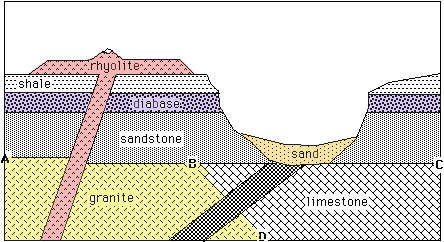
2) Using the cross section diagram below do the following. List from 1 to 7, oldest to youngest, by relative age the given rocky types. (5 pts.)
3) Lord Kelvin estimated the age of the earth in the 1860s as no more than 15-20 million years on the basis of mathematical equations that could describe the conductive cooling of a sphere. List 4 parameters in those equations that determine the history of a cooling sphere. (3 pts.)
What was not known of in Lord Kelvin's time that makes this good science, but with a false premise, so that it underestimates the age of the earth. _____________________________________________________________
4) Roughly how old are the oldest known rocks on earth? (2 pts.) _______________
5) The ratio of a radioactive isotope X to its daughter product Y was measured to be 1 to 7 in a sampled mineral. If the half live is 26 million years how long has it been since the "clock was set", the system was closed and Y started accumulating in the mineral due to decay of X. _________________________
b) This assumes that the mineral had no isotope Y in it to start out with. For some minerals and isotopes this would not be the case. If there was some original daughter product Y, would the measured age be greater or less than the real age (circle the right answer)?
c) If the ratio of another radioactive isotope W and its daughter product Z was measured to be 1 to 1 in the same mineral as above and the half life for W was 300 Ma, is the closure temperature of istopes W and Z higher or lower than X and Y? This is a thought question. (4 pts.)
6) List one of the important assumptions behind radiometric dating. ______________________________
Different radiometric clocks reflect different closure and
associated geologic events. For typical U-Pb systems the closure
event is _____________________. For the K-Ar system it is _______________________.
For Carbon-14 it is _____________________________. (4 pts.)
7) We talked about a host of -isms, and perspectives on
earth history: for each one of the following phenomena or geologic
events assign the most appropriate -ism that describes it. Two
examples are given. (4 pts.)
| wave that pave Lanai | |
| Milkanovich cycles | |
| large impacts | |
| Velikovsky hypothesis of Venus passby of earth | |
| a cooling earth | gradualism |
| large igneous province production | |
| Cambrian faunal explosion | punctuated equilibrium |
Write a few summary sentences characterizing the nature of
geologic history as you understand it. This is a difficult thought
question.
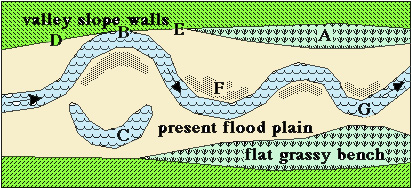
8) Name the three types of load a river carries. Mark with
an X the one characterized by the coarsest debris? Mark with a
check the one that contributes to the saltiness of the oceans.
(3 pts.)
a) _________________________________
b) _________________________________
c) _________________________________
10) List four critical factors that determine slope stability. (4 pts.)
a) ________________________________
b) ____________________________________
c) ________________________________
d) ____________________________________
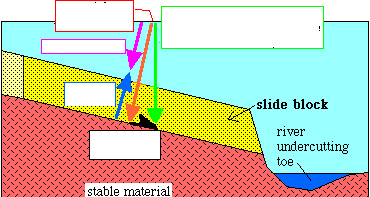
11) Label the various forces as to their names and their role in deciding whether slip occurs. Mark with an X the force (vector, arrow) which commonly grows in the spring in areas of snowmelt? If significant tilting occurred due to intrusion of magma underneath, which force would remain unaffected? ____________________ (3pts.)
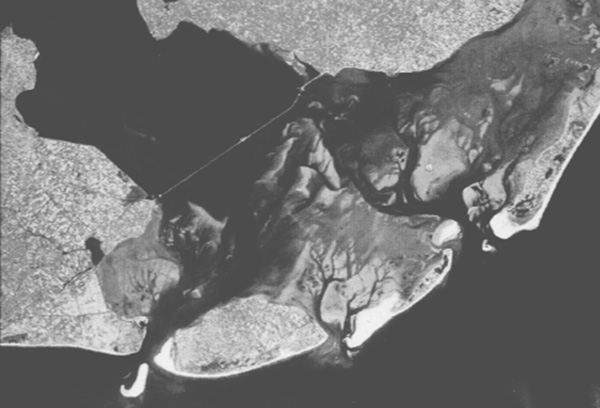
12) Consider the three end member types of deltas with different forces predominating in shaping the upper, near shore sediments. Match the delta type with the most likely character of the upper sediments. (3 pts.)
| River dominated delta | numerous storm deposits, and mainly sand (little mud) |
| Tide dominated delta | local coal deposits, and unimodal (one dominant direction) paleocurrents |
| Wave dominated delta | bimodal paleocurrents and lots of mud |
13) Describe longshore drift and its importance. (3 pts.)
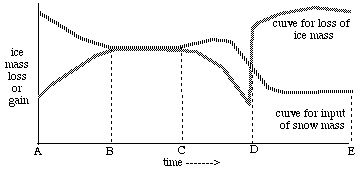
15) Use the graph below to answer the following. Note the time scale is broken up into four time segments (e.g. time AB, BC, CD,DE. (4 pts.) a) For what time segments do you expect glacial advance? _______ b) For what time segments would you expect a terminal moraine to form? _______ c) For what time segments do you expect glacial retreat? _______ d) If this was for all of Antarctica during which segment will sea level increase? ______
16) List 6 distinctive landforms or deposits that are telltale signs of past glaciation. (3 pts.)
a) ________________________________
b) ____________________________________
c) ________________________________
d) ____________________________________
e) ________________________________
f) _____________________________________
17) List 2 controlling factors for the position and geometry
of cave passages in a karst terrane? (3 pts.)
a)____________________________________________
b) _________________________________________
18) A later phase in the history of a cave is infilling. What type of material fills the cave in with time? (4 pts.)
19) On the field trip we saw the three local rock units listed on the left. Make the best connection with the other three columns by drawing lines clearly connecting the terms in the four columns. (3 pts.)
| Dakota Fm. | glacial outwash | youngest in age | limestones |
| Kansas City Group | marine sea | middle inage | x-bedded sandstones |
| Pleistocene deposits | fluvial system | oldest | gravels and tills |
20) Create a question that you think may provide some new insight into some of the geology that we have discussed in this second part of the course, but which was not asked in the above questions. You need not answer the question. Some of the more interesting questions will be reported back to the class. (up to 4 pts.)