Some possible answers to questions
posed - Physical Geology introductory lecture.
Physical geology
as a discipline is evolving into earth system science.
What does that mean?
 We can start with a simple metaphor. If you
want to understand how a motor or clock works you take it apart,
study the parts and their character, then note the arrangement
of the parts, and then put it back together. You change one part
and then see how it affects performance and thereby understand the system better.
As a graduate student I was amazed to find with my old and rusty VW fastback
that there were all sorts of pieces that it didn't seem to need. Other
pieces were critical.
Natural science is similar. Focusing on and
studying one part is a reductionist approach. Studying
one mineral in a rock would be an example. Putting parts together
to understand the operations of the larger system is an integrationist
approach. Both are necessary in natural science, but often you
start with a reductionist approach and move on to integration
of the components you understand. With new tools and driving questions
geoscience is embarking on more of an integrationist approach.
If you want to understand what happens inside the earth's crust
it turns out that not only are the rocks important, but the fluids
that move through them, and the life that lives in them. Fluid
dynamics, biology and geology begin to merge into earth science.
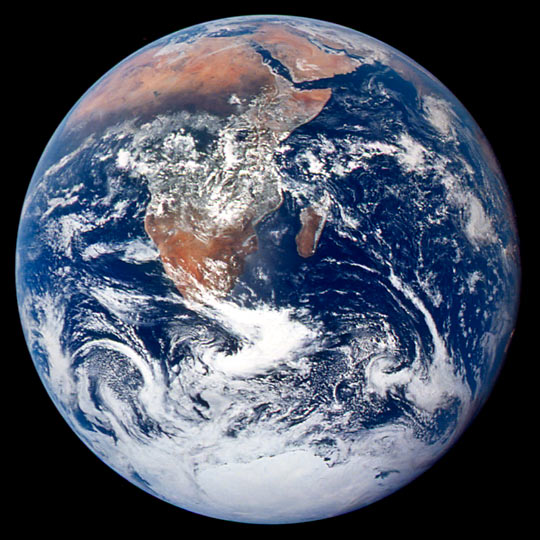
Here are some of the large system bits we now are integrating:
- atmosphere.
- hydrosphere.
- biosphere.
- cryosphere.
- lithosphere.
On the image in the upper right can you identify each of these components? Image source: http://visibleearth.nasa.gov/view_rec.php?id=1597
Why would one
want to learn about the earth?
Specific earth science knowledge is useful.
- in resource management, especially in the discovery, extraction and waste disposal aspects, all of which include environmental and sustainability considerations. These resources include groundwater, fossil fuels, soils, metallic ores and building stone material such as gravel and cement, resources that are core to modern society.
- as a career and in professional practice
( e.g., geologists, environmental scientists, civil engineers,
planners, lawyers).
- in personal endeavors (e.g. avoiding hazards,
future problems when purchasing property).
- in civil issues and having an informed citizenry (e.g. voting and being involved in all sorts of issues with a
geologic component such as waste disposal, water resources, and climate change).
This aspect is addressed more in our Environmental Geology (GEOL
1010) course.
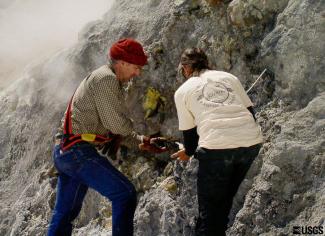
- In geohazard risk assessment (earthquakes, landslides, floods, volcanic eruptions and much much more) -Indian Ocean tsunami
example. Image to right is of USGS scientists collecting volcanic gases at Mt. Hood in Oregon. Changes in such gases can signal an eruption. Image source: https://volcanoes.usgs.gov/volcanoes/mount_hood/mount_hood_monitoring_98.html .
Such knowledge helps develop useful mental skills:
- will provide experience in and tools for
understanding complex problems and systems.
- ecology, economics and psychology are other good examples of disciplines focused on understanding complex problems and systems.
- geoscience is multidisciplinary by nature.
Aesthetic appreciation of the world around
you:
- most intangible, but most valued by some.
- this course should literally change what
you see as you travel through this world and life. Landscapes and rocks contain the stories of their formation within themselves if you learn how to read them.
- Loren Eisley: Nebraska author who explored the intersection of geology and literary art. More info.
What is involved
in the scientific process?
Below is a list of some of the components that
people often include.
- generation of models, ideas, hypotheses,
explanations.
- data gathering, observations, measurements.
- data analysis.
- testing, comparison, experimentation
- repeatability
- publication and peer review.
- modeling.
The next question might be as to how they fit together.
What is the induction
method?
The following is from Hempel (a historian of science):
" If we
try to imagine how a mind of superhuman power and reach, but normal
so far as logical processes of thought are concerned, .... would
use the scientific method, the process would be as follows: First
all facts would be observed and recorded, without selection or
a priori guess as the their relative importance. Secondly, the
observed and recorded facts would be analyzed, compared, and classified,
without hypothesis or postulates other than those necessarily
involved in the logic of thought. Third, from this analysis of
the facts generalizations would be inductively drawn as to the
relations, classificatory or causal, between them. Fourth, further
research would be deductive as well as inductive, employing inferences
from previously established generalizations. "
This can be distilled to the four following
stages:
- "observation and recording of all
facts,
- analysis and classification of these facts,
- inductive derivation of generalizations
from them,
- further testing of the generalizations."
Induction: generalizations from specific cases, that can be applied elsewhere.
What is shared
by a scientific community? Kuhn's suggestion as to four critical
components are given below.
- exemplars:
an explanation and the data it explains, training modules for
the initiates. This is a focus of what you learn in a typical college course.
- metaphysics:
e.g. historical continuity of basic physical laws.
- language: e.g.
statistics for psychology.
- values: e.g.
honesty.
Note that there can be significant overlap, shared exemplars, metaphysics, language and values between different scientific disciplines.
How can we understand complexity?
- To understand a complex system an initial requirement is to understand how the parts work in isolation. This is classic reductionist science.For example, in order to understand river behavior, you have to understand the physics of how water can move a particle. Isolating and simplifying a system in a lab beaker is perhaps an iconic image for reductionistic science. However, when the parts are combined they show new types of behavior only possible through the combination, a phenomena known as emergent properties - new behavior/properties emerges from the combination of parts. So while reductionist science is a necessary foundation, other tools are needed for understanding complex science.
- Conceptually we can use system diagrams (boxes and arrows to start with). Think of the water cycle as an example. We will also work with the rock cycle in this course. Feedback loops are an especially crucial type of behavior to understand.
- Certain concepts such as feedback loops, chaos and initial conditions sensitivity, strange attractors and fuzzy logic are also useful in understanding complexity. These terms may not make much sense at this point, but need to be developed as the course goes on.
- Computer models can be used to keep track of all the parts, interactions, and large amounts of dat, and to do the repetitive and tedious math required. A remarkable example are global climate models.
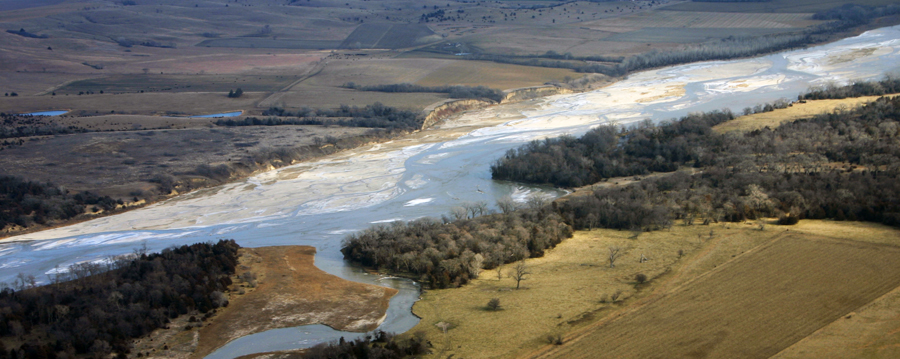
This is image of the lower part of the Niobrara River in Nebraska. It is a good example of a braided river system. Think of the myriad of factors that contribute to why this river has the pattern and behavior it does. Precipitation patterns, vegetation, the amount and type of sediment, the slope, river ice in the winter, groundwater interaction, and much more. It is a good example of a complex system.
Chaos - what is it?
- complex behavior from simple systems (e.g.
sand slips on a sand pile).
- long term unpredictability of precise system configuration
versus predictability of long term behavior patterns .
- related concepts are strange attractors,
self organization, fractals and scale invariance (some of the
jargon). We will be learning about some of these in this course.
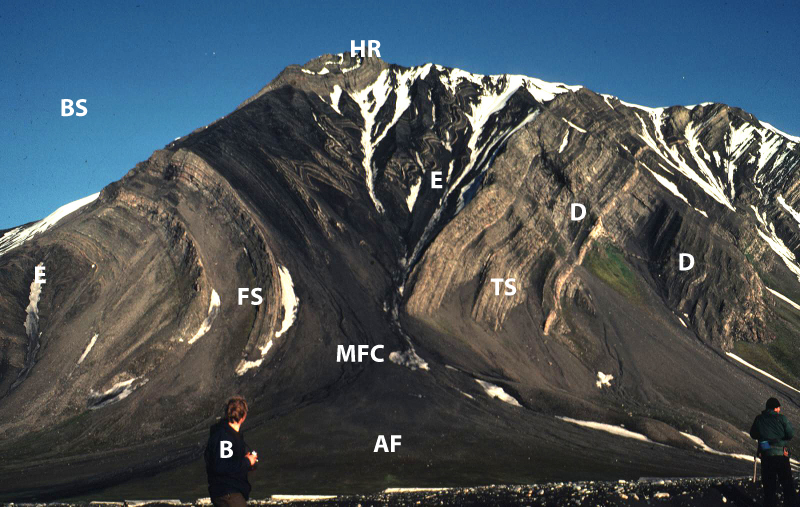
Basically, one sees a mountain side. Often insights come from asking questions. How did this mountain form and is being shaped at present. What features are exposed in the mountain side, and how did they form. Here are some more specific thoughts that might come to mind when viewing this image with some training in geology:
- E - There are areas where small V-shaped notches are presently eroding into the mountain side. If you were to turn around you would see glaciers, and these become the likely suspects for carving the large scale topography. But the small scale V-shaped notches have streams running in them, fed by the melting snow, and streams can erode.
- AF - This fan-shaped, relatively smooth body at the foot of the mountain is an alluvial fan, a depositional feature. This is where a lot of the sediment eroded from the mountain side above ends up. On the higher and steep slopes the water moves more swiftly, and picks up sediment. When the water and sediment reach the lower and flatter slopes the water slows down, and deposits the sediment.
- MFC - These sinuous forms have a form characteristic of mudflows (mobilized mud and rock debris), which is one of the mechanisms that transported sediment from a higher to a lower position and also helped build up the alluvial fan.
- HR - The lighter colored and layered rock here is more resistant to erosion (harder rock), while the darker is more prone to erosion. They are both very well and continuously layered, a characteristic of sedimentary rocks. They have the appearance of sandstone and dark shale respectively.
- TS - These are tilted strata. Since sediments start out flat lying, something has happened to tilt the rocks up. Such large scale movements are known as tectonics, so this area has suffered tectonism. This happened well before the present day topography was created.
- FS - Not only are the strata tilted, but some of them are bent into a curved form, folded. Folding of this type occurs where two crustal blocks move closer together - a certain type of tectonism known as crustal shortening. However, care must be taken because some types of folds can form in other ways. However, it is clear that some sort of tectonics was involved.
- B - This is a brother for scale (quite handy), and so these are fairly large scale features. Scale is an important consideration.
- D - Hard to see, but a thin line cuts through the layers. This is the form a dike takes. A dike is a crack that opened up and filled with something, usually molten rock, that then solidifies.
This is a start. The textures, colors, patterns, and even smells of rocks vary widely, and provide information on the history and the how and why of what can be seen. This course will help you begin to read that record.
Harmon D. Maher Jr. reserves
copyrights to the materials in this site. Material may be used
for non-profit educational purposes as long as proper attribution
is given. For permission for any other use please contact author.
Thank you.